Blog

Responsibility

Responsibility is something that’s been floating around my mind a lot this week for various reasons.  One is just how busy my schedule got.  Okay, maybe not busy, but hectic and a little disorganized in the short term.  There wasn’t a lot of personal downtime in the past few days, plus my “normal” schedule hasn’t started for work yet, which means, just in general, I’ve been a little thrown off center for a bit.

Which lead to practice.  There are so many projects in the works and so much I want to work on.  (Plus, the announcement yesterday that there’s a faction of the flute community that wants to bring Lizzo to NFA 2020, so I quick need to get going on helping with that campaign a little.  If you’re curious check out Leah Stevens’s Instagram account!)  Through all of that, though, I know it’s goals and responsibility to others that keeps me focused.

It ties back to the collaboration post from last week.  (Check it out here, if you didn’t get a chance yet.)  Even though the competitions and auditions I’m thinking about doing are goals, they aren’t what’s been driving me this week.  It was the text that our trio music came in and the explosion of joy and excitement in our text stream.  It was the knowledge that we start rehearsals in a week and a half and I have to be ready to go.

Today, especially, was a long hectic day.  I didn’t get home until after 8:00pm and wasn’t ready to practice until groceries were safely put away, but I did.  From 8:10-9:00pm it was all tone, articulation, and scales, to which you say: “What Samantha?! That’s not rep!”  No, it’s not, but it’s going to help me be better and more prepared for when I have time to really dig into our chamber works and our solo works.  When I do have that time, when it’s time for our first rehearsal, I know I’ll be ready to play and ultimately prepared on my part and ready to make music with two wonderful musicians who drive me and inspire me and frequently keep me accountable.

Happy Practicing!
Collaboration

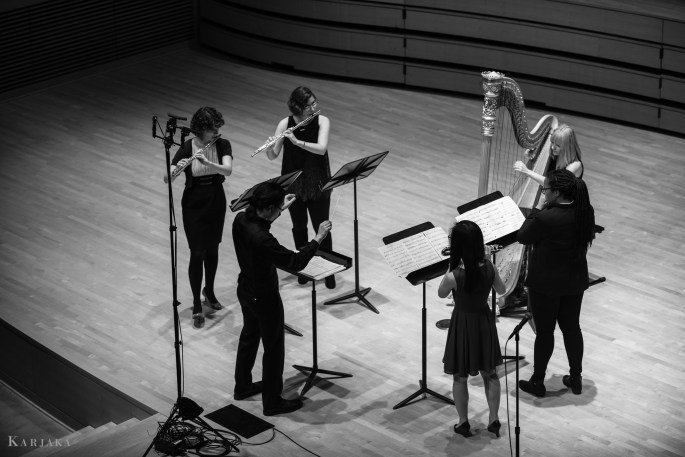
So, definitely behind in posting this, again.  Moving will throw you for a loop that’s for sure, but it, along with many other things, can also show you the beauty of collaboration.  It’s funny how easy it is for many of us to downplay the importance of collaborating with other musicians and other people.  We lock ourselves in our practice boxes, stare at a music stand, and hopefully, get around to playing for other people…eventually.  The thing with that model is…eventually it becomes really hard to find motivation or dedication in what you’re doing.

Now, take a step back.  Find a buddy.  They can be another musician, or a dancer, or an artist, or even a historian.  Start talking.  What lights your fires?  What drives you?  What pushes you towards your goals?  Among these, what do you have in common?  Now, try to keep the conversation going?  What do you find starts happening?

More likely than not, you’ll have a project that starts to form.  You’ll have ideas that take shape and your drive will sky-rocket.  You’ll find ways to keep each other focused, dedicated, excited, and motivated through the entirety of the process, because as one of you gets tired the other (or others) will take over for a while.  In collaboration, other people rely on you and you develop your own little team of internal cheerleaders.

It’s crazy how quickly we forget collaboration is important.  It’s crazier to realize how quickly we forget how important it is to collaborate with people we love.  Being out for blood (entirely goal oriented) is not always the most efficient way to achieve a goal and it’s certainly not the most sustainable.  When we put love and friendship at the core of our collaborations, everything shifts and suddenly, our art does what it was always supposed to do.  It changes lives.

Happy practicing.

Changes

Change is inevitable.  Sometimes it’s good change, sometimes it’s bad change.  The one thing we can always know is that regardless of whether the change is for better or for worse, there will always be a little of both involved.  Change can be moving or starting a new job.  It can mean leaving what you know behind or coming home after some time away.  Two positive things that change can bring about for music, and maybe for life, are a fresh perspective and concentration boosts.

When you change where you are, your view on things often changes with you.  Maybe you go from living 5 hours away from your friends to living down the block again.  That’s a totally different perspective and it will also affect your music.  Being down the block might inspire you or it might distract you horribly.  You’ll have to be ready to compensate for either scenario, because we can neither afford to practice 24/7 because we’re inspired, nor can we afford to ignore our instruments entirely for the sake of spending time with those we love.

Which also leads to concentration.  Back during my gap year in 2012-2013 I remember having a conversation with my flute teacher.  She asked where I was practicing and, like the distracted-by-masters-auditions twenty-something I was I responded with “at home?” She gently suggested that maybe I find a place to practice that wasn’t home because it could shift my focus, or at least have a dedicated space for my music where I wouldn’t be disturbed.

As we get older, all of that becomes harder.  Outside of music school, practice rooms are hard to find.  If you live in an apartment, it’s hard to have a dedicated room to your music making.  That said, it doesn’t mean you can’t change things up.  On a beautiful day, maybe you practice outside.  Maybe you create a dedicated space in your room where you practice.  Somewhere where, when you are there, you know not to touch your phone.

Writers do this all the time.  They’ll either have an office in their home where their family knows they aren’t to be disturbed when working or they’ll go to a coffee shop and write.  It’s a little harder for us, but it’s the same principal.  A change of scenery can help you concentrate.

Now go make a change for the week.

Happy practicing!

Balance

Balance is…tough.  I was having a conversation with one of my close friends this morning.  She’s working to figure out exactly how much she can fit in her life and her schedule, a problem many of us are familiar with.  We’re trained, as budding artists, to say yes.  Whatever comes your way, accept it, as long as you can do it well because you never know what connections you’ll make.

What happens when you can’t say yes anymore?  When you’ve overextended yourself, even though you’re still fulfilling all your artistic gigs perfectly fine.  What happens when your hobbies, personal life, and personal wellness begin to suffer?  It’s something we’re all guilty of when we’re in school.  Say yes to everything, don’t sleep, ignore the anxiety, and…oh yeah!  What’s that thing called exercise?  Then we get out of school and have to function in the real world.  Slowly we realize that lifestyle isn’t sustainable, that we have to make decisions.

If we keep taking every gig that comes our way and we don’t sleep, but we do everything else we’re bound to get physically hurt when exercising and probably not have enough attention to give to the people we love who are so incredibly deserving of our love and attention.  If we ignore the people we love to get enough sleep and exercise and eat well, we will never be fulfilled in our lives because we will lose our family and friends.

Life is a delicate balance.  It’s a balance no one claims is simple, but it’s critical.  There’s a running joke in the fitness world: “some days you eat salads and run and other days you lay on the couch and eat a whole pizza.  It’s called balance.”  That statement isn’t that far off.  Sometimes, you have to set your instrument aside to take care of yourself or others, but some days you practice yourself silly and your community understands.  Balance is learning your limits, learning what’s important to you, and learning where and when you need to take care of who and what.

So what’s your balance this week?

Happy practicing!

Performance Triggers

Okay, real talk: what changes auditions/performances for you?  It’s funny because it’s something most of us either don’t think about or choose to ignore most of the time.  When it comes to performance anxiety it becomes the philosophy of “ignore it and maybe it’ll go away.”  That…doesn’t really work, at least for most of us.  That said, neither does having someone tell us how we should handle ourselves.  Additionally, for many of us, we’ll have our butterflies in a net when we perform for years…until we don’t.  So, what makes that change?  What makes that shift in us?  Do we know?

After nearly 20 years of playing and performing (now that’s a terrifying statement!) I think I might be starting to figure out what triggers things for me and what doesn’t.  The first thing that makes a difference is how much I’m performing.  It doesn’t have to be performing on flute, any sort of performing helps.  It’s come to my attention that the more I teach dance fitness (so I’m up in front of a crowd multiple times a week frequently teaching choreography I’m not super familiar with) the more confident of a performer I feel I am.  It doesn’t seem to matter that I don’t have a flute in my hands when I’m dancing, what matters is the frequency that I’m up in front of a crowd doing something artistic.

When performing chamber music with people I care about, I also find myself calmer.  The notion that we want each other to succeed and grow through each performance helps make things easier.  We all know we have each other’s backs if something goes wrong and that no one wants to sabotage anyone else mid-performance.  (NOTE: sabotage within chamber groups is not a normal thing!)

Also, self-distraction before walking out onstage is helpful for me.  Grabbing my phone and texting people…who would consider that a coping mechanism?  For me, however, it works.  It keeps my mind off of what I should be doing (ie. worrying about how a certain measure is supposed to go) and focused on talking to people who matter to me and want to see me succeed.

So what does any of this mean for you?  Well, we might share some triggers and be able to understand from each other that when one aspect changes we might feel differently in the same circumstance.  It also means that a key feature of this is (buzzword) mindfulness!  In the last few years I’ve become a huge advocate of Headspace and being more mindful of yourself in general.  It helps, additionally, with becoming more mindful of your performance triggers, particularly if you use the training/sport packs.  Last word of advice, check out https://bulletproofmusician.com/blog/  Dr. Noa Kageyama. He teaches at Juilliard and has his degree from Jacobs school at Indiana University where he combined sports psychology and music into what he does now, which is study effective practice and performance anxiety.

If you feel comfortable, please share your triggers and coping mechanisms, as well.  You never know when your words will change someone’s life.

Happy Practicing!

The Importance of People

Some people call them their network. Some people call them their support system. Some people just call them friends and some take it a step farther to call them family. The only thing many of us know is we wouldn’t be who or where we are today without them.

People who grew up in the 1990’s often watched a show called Boy Meets World which was rebooted a few decades later into a sequel called Girl Meets World. For those of us who watched those shows we learned that the number one rule of life is as follows: people change people. That may be the most important lesson to learn in any field: people change people.

A research study was done where scientists discovered we become like the 5 people closest to us. ( https://www.psychologytoday.com/us/blog/what-mentally-strong-people-dont-do/201504/5-reasons-studies-say-you-have-choose-your-friends ) Obviously this changes over time as we grow and the people around us grow with us. What it means, however, is our friends and family contribute far more to our successes than we may initially care to admit.

So, if your friends prize hard work, you are more likely to. If they hold taking care of each other to a high standard, you are more likely to return that towards others. This isn’t to say: be careful with whom you associate. It’s more to say, our people make a huge difference in our lives, more than we generally realize, so try to thank your 5 closest people today if you can…and maybe give them a hug if they’re close enough.

Happy music making.

Summer

My sincere apologies friends.  Last week, coming back from my summer program, I was just so exhausted that I never managed to get anything written or posted.  Honestly, I probably should have expected that level of exhaustion, but…well, live and learn, I suppose?  Either way, I’m back this week.

What’s changed in the last couple of days?  Well, to begin with, it’s actually finally summer, at least where I live.  Summer.  90°, sun, and all that good stuff has finally arrived.  Of course, with that comes the bad parts about summer.  I know, I know, what could be bad about summer?  Olaf is somewhere with his heart melting faster than the rest of him because I said that.

In spite of Olaf’s warm heart melting extra fast because of pointing out that there are downsides to summer, there some.  It’s easily my favorite season, but it’s so easy to get distracted and lose motivation.  Honestly, it’s about as easy as it is in the miserable middle of winter.  The warmth and sun seduce you into going outside and spending every second you can enjoy that heat and “human-photosynthesizing”.  Unfortunately, as musicians, that’s not really something we can give into on a regular basis. 

One of the best tricks I have to combat the sun-siren is a practice plan.  It’s a notebook where I write down everything I want to accomplish in my practice sessions and as I accomplish it I also make notes about what I can improve tomorrow (or focus on tomorrow).  It helps enormously.  Personally, using a timer also helps me.  If I limit myself to 15-30 minute segments of practice, then I can focus on practicing and take breaks in between, which can be a great excuse to get outside and enjoy the weather.

Still, there are times that isn’t enough.  Which means, it helps to have a goal.  To start prepping a recital and schedule it somewhere, to find an audition or a gig to prepare for.  All these things help keep me on task and I know they help keep some of my peers in shape, as well.

Of course, the ideal is if you live in an area where you can just practice outside.  The best option is to always get the best of both worlds.  Practice and enjoy the weather.  Falling short of that, if you can make some time to get outside, especially in the summer, please do.  It’s important for everyone, perhaps most particularly musicians.

What do you do to prevent or “treat” summer fever that we don’t talk about?  Or do you hate summer and live for winter, cold, and snow?  I’d love to hear your thoughts!

Exhaustion

Okay, talking point: when does exhaustion go too far? It’s a topic that’s been buzzing around in my head a lot. We’re musicians, we push ourselves to the point of total and complete exhaustion, isn’t that what we’re supposed to do? Go to bed at 3:00am get up at 5:00am, run on two hours of sleep every night for the rest of our lives and still somehow not snap at people?

If that situation doesn’t feel familiar, maybe try this one: go to bed at midnight, wake up at 7:00 or 7:30, you got a decent amount of sleep, maybe you can get in sometime to yourself to work out, but maybe you are then expected to be around people (and functionally interacting with them) from 9:00-9:00. You come home and you don’t want to people, but you have a concert, so you have to. You get to bed at midnight, and wake up at 7:30, but you’re still tired and introverted.

Feel “targeted” yet, like these stories hit too close to home some days?

It’s not a topic we’re supposed to discuss. Period. Not in music, not in business, just don’t. Our society dictates we’re not allowed to be tired, we aren’t allowed to be introverted, we aren’t allowed to be, well…us. Every introvert I know has a coping mechanism, until they don’t. For me it’s caffeine, running, and meditating. I will intake caffeine at ridiculous levels so that I can be social in what I do. I will run to get my space from people and boost my endorphins in order to be social. I will meditate to get some peace and quiet and let my mind recharge a little bit. Most of the time these things work well, until my people-meter, usually unexpectedly, crashes.

That happened to me last night. I was supposed to be at dinner with friends being social and I walked in, hit by a wave of noise and laughter and over stimulation and, after being around people for three hours, knowing I’d have two more hours around people, in general, I couldn’t do it. I retreated to a corner in the sun, by myself to “photosynthesize,” as one of my friends called it.

So the question becomes less a question of: how do I cope, though please share your coping mechanisms if you’re comfortable doing so and more a question of how do we recognize these problems, find our space to recharge when we do crash and successfully come back to the real world. It’s hard, because the real world doesn’t like to accept that we all can’t go full throttle 24/7, 365 days a week. It likes to believe we can.

Obviously, the best ways for us to come back are to not let our energy get so low that we have to disappear, but it happens. One time it happened, I remember a fight that occurred because no one understood what was going on. In the end, that fight became a good thing because all parties understood each other better, but in the professional world, that isn’t always feasible. Do you take a day off of work to be alone and recharge? Do you try to hide how tired you are until the end of the week when you can hide away from everyone? Is there a different method that hasn’t been touched on here? It’d be a great conversation to have.

Beyond that, how do you find all of this affects your music? Does it make it harder to play when you’re in that state of mental, physical, and emotional exhaustion? Does it make you a stronger performer because you get to go into your performance box and not talk to anyone, except through your instrument? Share your thoughts and ideas. Let’s have a conversation.

Motivation

What inspires you to make art?  It’s not a particularly easy question to answer, unfortunately.  For some people it changes from day to day, for others, they know what it is their whole lives.  However, many can lose their motivation as real life (or school) comes in to play more and more.  Technically, this ties into last week’s post about burn out, but from a different angle.  In a way, this is a question of how to avoid just that, if you can tap into your motivation, perhaps you can keep burn out at bay, at least a little bit.

So, take a second and think, what fuels your fire?  Is it the joy of playing?  Is it the desire to share art with the wider world?  Do you feel like when you hear a piece of music it can change your whole day and you want to share that with the world to the best of your ability?  It’s something that seems to be a critical question for many of us: how do we find our inspiration and motivation?

It’s an ongoing question for everyone, because motivation can change from day-to-day and month-to-month, let alone year-to-year.  That said, for many of us, there is an underlying drive or passion that keeps us going.  For me, it’s knowing that the art I create may change someone’s life for the better and the prospect of creating art for and with the people I love.  To me, that is the most critical aspect of my art, but maybe it’s not for you.

Take some time to think about what drives you and chime in with what your motivation is when things get tough for you!  You never know, you might find a chamber partner in the comments section! What inspires you to make art?  It’s not a particularly easy question to answer, unfortunately.  For some people it changes from day to day, for others, they know what it is their whole lives.  However, many can lose their motivation as real life (or school) comes in to play more and more.  Technically, this ties into last week’s post about burn out, but from a different angle. In a way, this is a question of how to avoid just that, if you can tap into your motivation, perhaps you can keep burn out at bay, at least a little bit.

So, take a second and think, what fuels your fire?  Is it the joy of playing?  Is it the desire to share art with the wider world?  Do you feel like when you hear a piece of music it can change your whole day and you want to share that with the world to the best of your ability?  It’s something that seems to be a critical question for many of us: how do we find our inspiration and motivation?

It’s an ongoing question for everyone, because motivation can change from day-to-day and month-to-month, let alone year-to-year.  That said, for many of us, there is an underlying drive or passion that keeps us going.  For me, it’s knowing that the art I create may change someone’s life for the better and the prospect of creating art for and with the people I love.  To me, that is the most critical aspect of my art, but maybe it’s not for you.

Take some time to think about what drives you and chime in with what your motivation is when things get tough for you!  You never know, you might find a chamber partner in the comments section!

Let’s Talk About Burnout

Sitting across the street from my youth orchestra in a McDonald’s this morning, it suddenly started to hit me how much we don’t talk about burnout, which is such a “heavy hitter,” in our field.  How it’s that “dirty word,” for professional musicians, much like “practice,” when we’re younger and much like “depression,” for the rest of the world.  We don’t talk about it because we’re just supposed to tough it out, but…what happens when we can’t anymore?  What happens and what do we do when we feel that spark begin to die inside?

I’ve been quiet on here for several years because my time has been spent elsewhere.  Playing, audition preparation, taking lessons, playing in small ensembles, moving, working, etc.  Somehow writing about my experiences became less important as I became busier.  The more the pressure of performing at a certain level increased, the less drive I had to pay attention to anything else, but the less I wanted to perform at that specific level anymore.  Eventually, that came to a head when…I needed to get away for a little while.

This is not a unique experience to me, either.  There are many musicians I know who struggle with this.  Their spark has been dimmed or extinguished and they struggle to find joy in what they once loved.  There are things we can do to help ourselves kindle that spark again.  We can meditate.  Work an extra job in a field we love and break away from our little music bubble.  We can talk to our musician and non-musician friends on the phone and talk about our experiences, but in the end, everyone’s reaction to burn out is unique.  How you cope and come back from something that feels like a crushing emotional and creative defeat is entirely unique.

For me, it’s been an ongoing process.  Some days are better than others and different factors light my fire at different times.  However, I’m lucky.  I caught my burnout fairly early and knew where to ease off and what to change in my life to keep my spark from dying, but not everyone is in that position.  I’m also lucky to have a support network that fuels me, even when I’m at my lowest.  That’s what works for me, but that’s not what works for everyone.  So, I wonder, and I encourage you to chime in: how do you deal with burnout?  You don’t have to be a musician to give an opinion.  Every career burns out in different ways, so how do you handle it?  How do you find your drive when it seems like it will never come back?